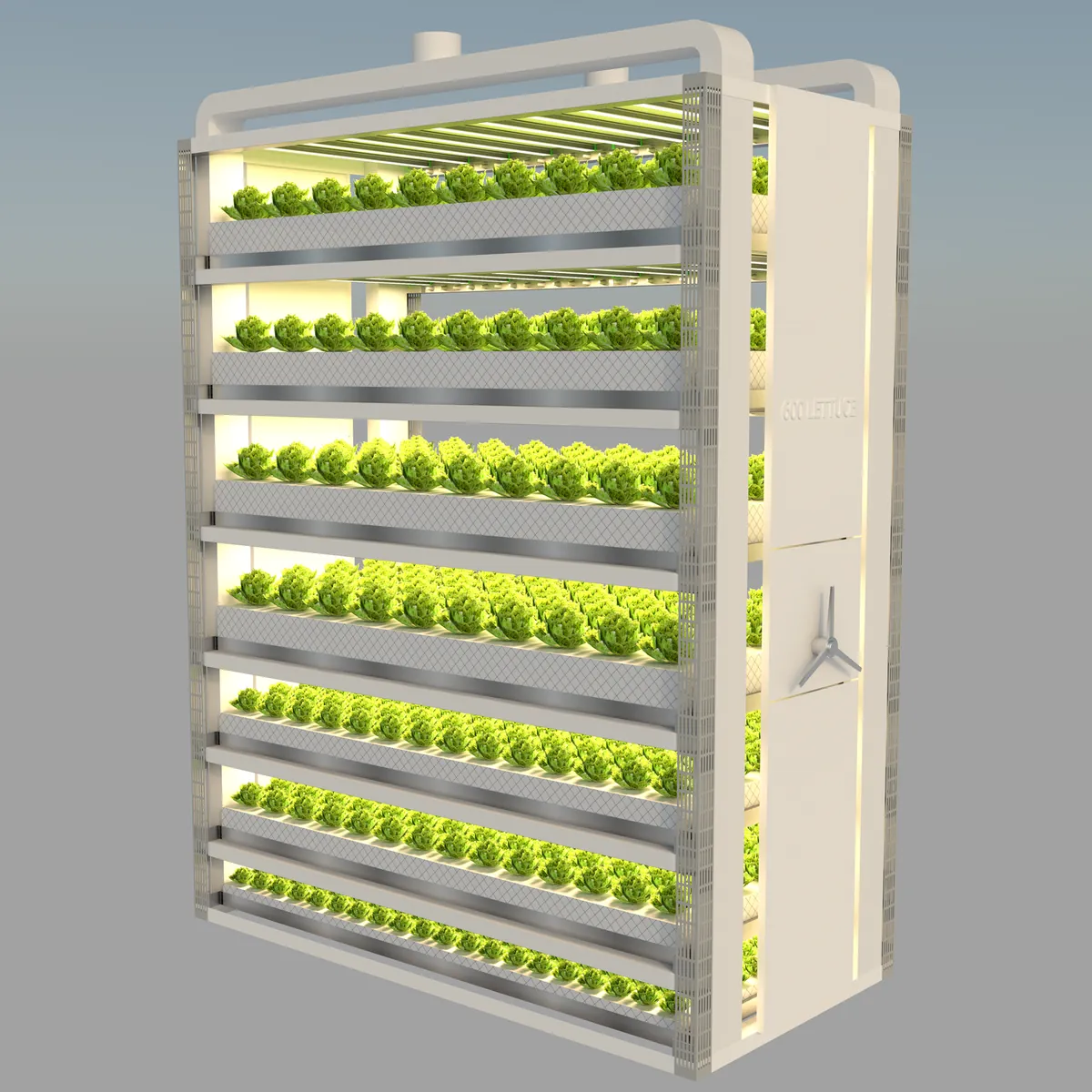
A seven-tier growing module with its own controllers
Each module stacks seven growing tiers. Every tier has its own LED bar, air temperature and humidity sensor, and controller.
Schematic elevation, not to scale.
The module
Seven-tier racks are built to our drawings by a contract manufacturer. Three sets were invoiced in December 2024.
What we design
- Embedded controllers and the sensor network
- FarmOS, the farm-management software
- Rack drawings
- The in-rack air-distribution duct, designed with CFD
What we buy in
- LEDs and LED drivers
- Pumps
- HVAC units
Detail A: one tier
- LED bar, dimmed per tier from our dashboard.
- Air moving over the canopy. Design target: 0.3–1.0 m/s. Target
- Air temperature and humidity sensor (Sensirion SHT4x), one per tier.
- Tier controller: STM32F401, running FreeRTOS.
- RS-485 Modbus RTU field bus to the module controller.
Schematic only, not to scale.
Climate and airflow
We designed an in-rack air-distribution duct with CFD (computational fluid dynamics). Under TÜBİTAK project 3231634, we compared seven duct and nozzle variants in SimScale, using the k-omega SST model.
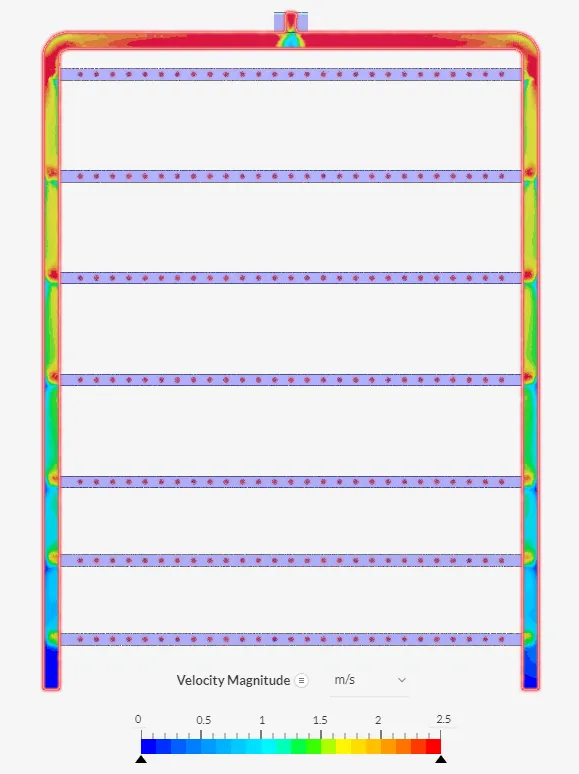
Target Our design target is an air speed of 0.3–1.0 m/s over every tier's canopy. Published studies link this range to lower tipburn risk [1, 2].
Every tier measures its own air temperature and humidity (Sensirion SHT4x). Each module also measures CO2 (Sensirion SCD4x).
Tier-level air-speed and light maps will be part of our next trial report.
Lighting
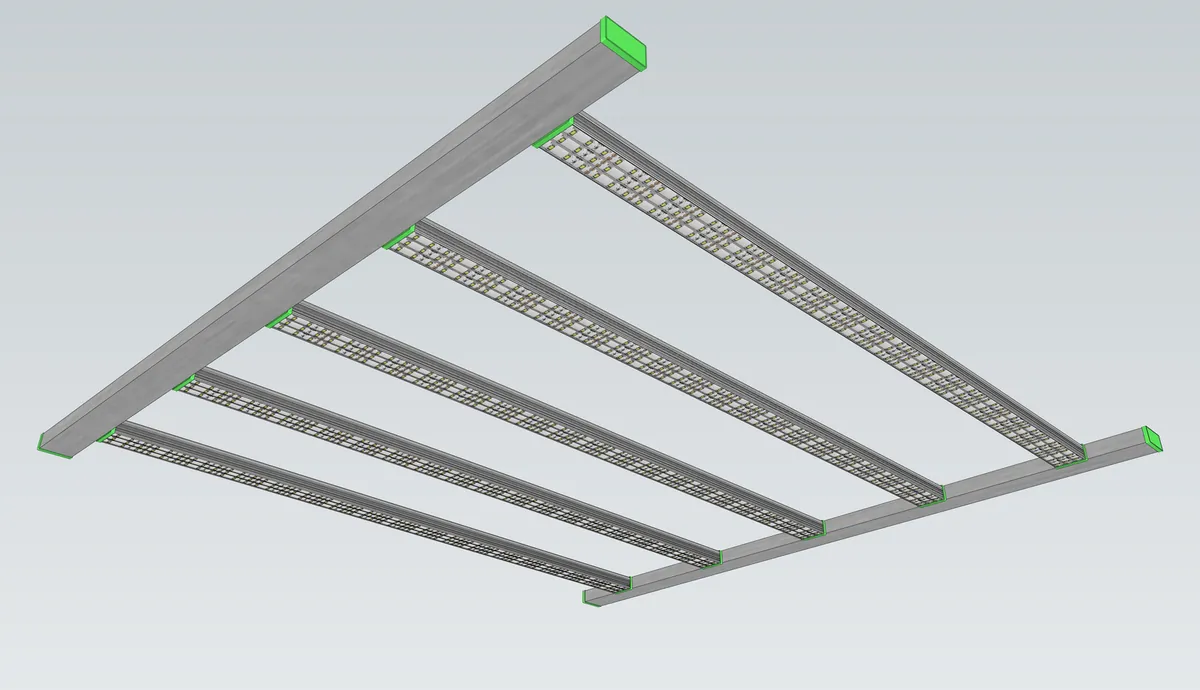
Under KOSGEB R&D project 60TZK, officially completed in June 2024, we built dimmable LED grow-light bars from Samsung mid-power LEDs and Mean Well drivers.
The bars are dimmed per tier by 1 kHz pulse-width modulation, in steps from 0 to 1,000. The level is set remotely from our dashboard, and the controller reports back the applied value.
In our 2024 light-mapping tests, white reflective side panels raised the average PPFD under our LED bars by about 75% at the same power. PPFD is photosynthetic photon flux density.
In development Our next-generation LED board has four channels: red, white, blue and far-red, at 48 V. It is designed in-house and is at the pre-prototype engineering stage. Tunable spectrum is therefore still in development.
We will publish LED efficacy only after independent integrating-sphere (LM-79) testing of production-intent boards.
Control and software
-
Tier controller × 7
One on every tier: STM32F401, running FreeRTOS. Reads air temperature and humidity; dims the tier's LED bar.
RS-485 Modbus RTU field bus
-
Module controller
One per module: STM32F407, running FreeRTOS. Measures CO2 and switches four relay outputs.
-
Gateway
ESP32-C3, version 3.0 (January 2026).
MQTT
-
FarmOS
Server, database and dashboard for monitoring, history, remote lighting and relay control.
How the stack behaves
Each module controller has four remotely switchable relay outputs, for example for HVAC, a humidifier and a pump. Their states survive resets and power cycles.
Firmware cleans sensor data with outlier rejection, a trimmed mean, exponential smoothing and a deadband. Watchdogs, CRC-protected parameter storage and CRC-16 framed links add reliability.
During 2025 prototype operation, the telemetry pipeline (controller, MQTT, server, database) carried sensor data from six tiers.
FarmOS provides a climate dashboard, per-tier monitoring with history charts, remote lighting and relay control, and task management. Its sensor-log reports are organised by facility, area, module and tier.
Control: design and roadmap
During TÜBİTAK project 3220859 (2023) we designed a rule-based (Sugeno) fuzzy-logic controller for climate and nutrient set-points.
FarmOS and our controllers provide remote monitoring and manual control of lighting and relay-switched equipment, while the HVAC equipment runs on its own thermostats.
Roadmap Integrated automatic control is on our roadmap.
Sources
- Zhang Y, Kacira M, An L (2016). A CFD study on improving air flow uniformity in indoor plant factory system. Biosystems Engineering 147: 193–205. doi.org/10.1016/j.biosystemseng.2016.04.012
- Lee JG and others (2013). Effects of air temperature and air flow rate control on the tipburn occurrence of leaf lettuce in a closed-type plant factory system. Horticulture, Environment, and Biotechnology 54(4): 303–310.